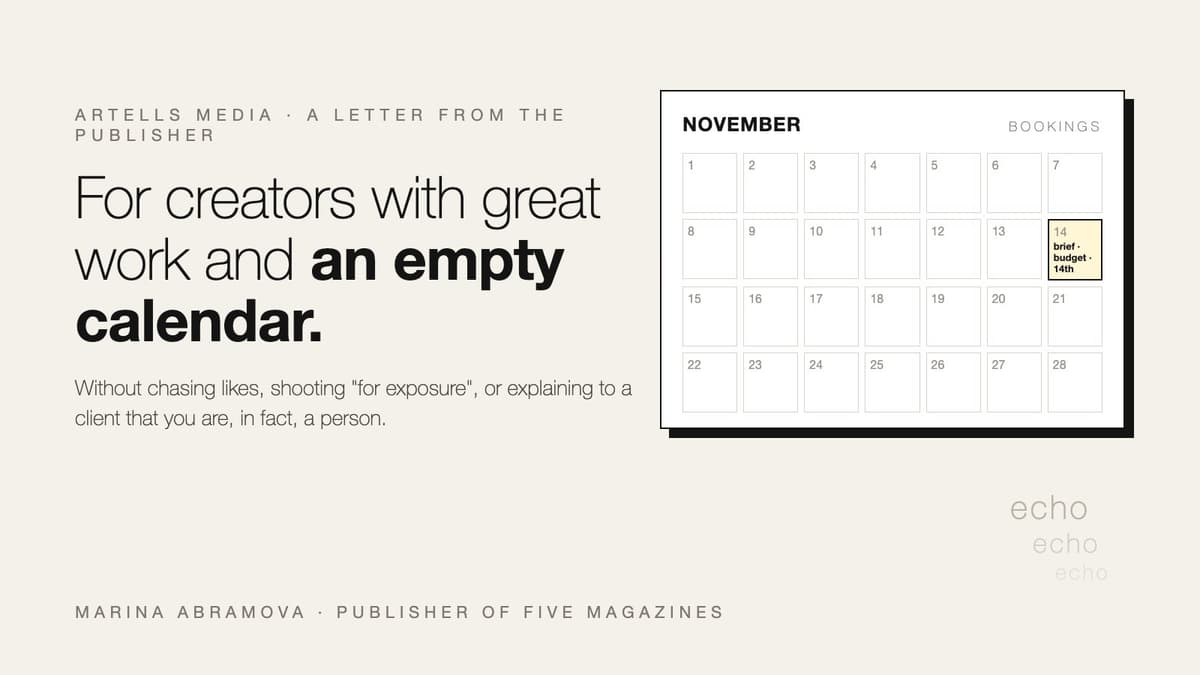
For creators with great work and a calendar so empty you can hear the echo…
Without chasing likes, shooting "for exposure", or explaining to a client that you are, in fact, a person.
If you're a photographer, a model, a makeup artist, a hair stylist, a fashion or jewelry designer, a nail artist, a painter, an illustrator or a digital artist, and your portfolio is strong while your bookings are thin, give me four minutes. This letter was written for you, by someone who has read 200,000 submissions and still has eyesight.
Here's why.
"My work is good. I know it's good. Clients who've worked with me come back," says the creator, to the cat, because nobody else is asking.
The inbox is quiet. Nobody writes first. The last message was a brand asking if you'd do a campaign "for the visibility". Visibility doesn't pay rent. I checked.
Sound familiar?
Why does this happen?
Most creators get few bookings because they picked a strategy where they have to sell themselves every day, like a street musician who has to earn the right to stand on the corner again tomorrow.
Post. Story. Reel. Cold DM. A "test shoot" for a tag. Repeat until you hate your own face.
And all of it on rented land. One algorithm decides who sees you, one model decides whether you exist, and the appeal form goes to a robot who's having a bad day.
Meanwhile the people with budgets quietly moved out. They don't scroll for a makeup artist any more. They ask an AI assistant, the same one they ask about the weather. "Find me a beauty photographer in Berlin with published work." "A model in Lisbon for a lookbook, with editorial credits." "A jewelry designer in Milan who's been in print." "A nail artist for a campaign in London." And the AI builds its answer from pages it can read: who you are, what you do, and what someone independent already said yes to.
No such page about you? Then to the AI you don't exist, and the brief goes to someone who does. Not because you're worse. Because you're invisible in the one place where the looking now happens. Being visible to AI is the new being visible, and a feed post isn't it. You've been shouting into the old room while everyone left for the new one.
What to do?
Read on and you'll see how one page can do the selling for you, so a brief lands in your inbox with a number attached, instead of you landing in a stranger's DMs with a discount and a smiley.
A creator's story
Every morning the same ritual. Phone. Stats. Reach. Low. Messages: a shampoo brand offering "product in exchange for content". The product is shampoo.
I'm Mia, I do makeup. Eight years, two of them with an agency that booked me for campaigns. I know faces. Clients who've sat in my chair send their friends, their sisters and one very confused husband.
This spring the agency said they'd "try a few looks in Midjourney first". They kept me for the behind-the-scenes video. The video is me doing makeup on a model who gets replaced in post. I was, technically, doing makeup on a placeholder.
So I did everything the internet tells you to do. Posted more. Reels with the process, ring light, the works. A giveaway. A shoot "for exposure" with a photographer who tagged me and got two hundred likes, of which exactly zero became a booking for either of us. The model posted the same photos to her forty thousand followers and didn't tag anyone. Two hours of my work, her face, my name nowhere. Then another shoot like that, because apparently I enjoy learning the same lesson twice.
Evenings I'd scroll other makeup artists. Fuller calendars, same skills, sometimes less. Then the thought showed up and sat down like it lived there: maybe the problem is me. Maybe I explain it badly. Maybe nobody needs this now. Maybe I take the counter job at the department store. Steady money. No algorithm. A name badge.
That badge scared me more than the empty inbox. I did not spend eight years learning faces to spend the next eight saying "would you like to try our new serum".
So I went looking for what the busy ones had that I didn't. A photographer, a stylist, a model, a nail artist I know, all with calendars that actually have things in them. It wasn't talent. It wasn't followers. One of them had fewer followers than my cat.
They had a record. Somewhere outside Instagram there was a page that said who they were, with publications under their name and a credit a client could click and check. And that page got found when someone asked for "a makeup artist for an editorial in Milan". Theirs got found. Mine didn't exist. I had spent two years shouting about my work and never built the one thing that could speak for me while I slept.
So I changed the system. I stopped selling myself daily and built the record once. One profile that says what I do. One series to a magazine. One frame a week to a feed where editors actually look, instead of a feed where my aunt looks.
An editor marked my frame in week two. The series ran in the issue the next month, my name in the credits with a link anyone could open. Three weeks later a brief came through the site from a small skincare brand. With a number in it. Not "let's collab". A number, a date, and a question about my availability, like I was a professional or something.
Nothing dramatic. I'm not rich. But the mornings changed. I open the phone to see what came in, not to check whether anyone noticed me. And I got my evenings back, because now the page does the talking and the page doesn't need a ring light.
How the system works
- You build one permanent record: a page about you that people, search engines and AI assistants can all read, so when someone asks an AI for "a stylist in Paris with editorial work", you're in the material it answers from.
- You put it where the traffic already flows: five magazines, a weekly feed the editors watch, a monthly Awards round, pages indexed with everything else.
- Briefs come through the door with a budget attached. Your contacts stay hidden until you say yes.
Looks simple. The difference is in the details nobody sees from the outside, and the platform was built around exactly those details, by people who have watched 200,000 submissions go right and wrong.
What you get
Step 1. A record that sells while you sleep
A profile on Artells Media with your specialty, your city, one clear line about what you do, and series instead of a pile of frames from five different shoots. Photographer, model, makeup, hair, stylist, designer, jewelry, nail artist, painter, illustrator, digital artist: there's a lane for each, and a model's page counts the same as a photographer's. Every page is written so that a machine can read it and a client can trust it. Send six to twelve frames that belong together to any of our five magazines, Artells, Artego, Marika, Figgi or Quadro, and an editor answers in about a week. A human editor. With a name. When the series runs, everyone on the team gets the same thing: a tear sheet, a credit on their own profile, and a verified link that opens without a password. The model, the stylist and the nail artist get the receipt, not just the photographer. Nobody can forget to tag you here, the credit is in the record.
That link is the end of "can you prove that?". It's the receipt. A client clicks once and the interrogation is over.
Step 2. Marks that only work can earn
Every Monday the Open Feed gets a new theme. You post one frame. The editors go through the week and mark the frames that caught their eye with the magazine's badge, and the badge stays on your profile for good. Once a month the Awards open: the jury votes blind, editors' votes weigh more, the top three go on covers, and there's no entry fee, which in the contest world makes us the weird ones. Everything you earn feeds your Creator Score, and the score moves only on things that can't be bought: publications, editors' marks, Awards, your own published stories.
You stop competing on likes, because nobody can buy what you've got. And the question "am I good enough" finally shuts up, because the answer is on the page with a date next to it.
Step 3. The door for briefs
Agencies, brands and galleries have verified profiles on the platform too. A brand can send you a brief with a budget through the site, and your contacts stay hidden until you accept, so no more "hi dear" at 2 a.m. The page is indexed, the door is open, and the creators who get found first are the ones who built the record first.
A brief has a number in it, or it's a compliment. We like compliments. We just can't deposit them.
What your mornings look like after
Imagine: you open the phone and there's a message from a brand, with a brief, a budget, and a question about the 14th.
Not "love your work!!!". A date and a number.
You didn't post yesterday. You didn't DM anyone. You didn't film yourself blending anything. The page did it, the editors' marks did it, the credit a stranger could check did it.
You make the thing, you send it once, and the record keeps working. The evenings are yours again. The question "maybe the problem is me" goes quiet, because the answer is public and it has your name on it.
What this costs
Building the record costs nothing. The profile, the series to the magazines, the inside pages, the weekly feed, the Awards: open to everyone, no card asked, no "trial" with a trapdoor.
The door for briefs is part of PRO, together with priority review and more entries. And the first month of PRO is on me.
Why would I give that away?
Because I want the stories. We've just opened the platform after seven years of running the magazines, and the thing that will sell it is a creator saying "I built the record and the brief came". Those stories do more than any letter, including this one.
So for creators who sign up in October, the first month of PRO is a gift. Not a trial with a card attached and a cancellation maze. A gift, and then you decide.
How to start
- Open artellsmedia.com and sign up with your email. A link arrives. No password to invent, forget, and reset.
- Pick your specialty, add your city and one line about what you do.
- Send one series to a magazine, and switch on your gift month here: artellsmedia.com/pro/redeem/ARTELLSMEDIAGIFT
Ten minutes. Then go make something and let the page work the night shift.
Who I am
Marina Abramova. I publish five independent print magazines, Artells, Artego, Marika, Figgi and Quadro, since 2019. Our editors have read about 200,000 submissions, and the issues are printed and sold in the US, Germany, Canada, the UK and Italy. This summer Instagram banned three of our magazines and seven years of readers went with them, by decision of a robot that doesn't take appeals. That's when I stopped building on rented land and built Artells Media: a place where a creator's record belongs to the creator, and nobody gets switched off.
Build yours: artellsmedia.com
Comments
Sign in to join the conversation.
No comments yet. Be the first.