Every month our editors look at a great many beautiful photographs and choose very few covers. The frames that don't make it are often better photographs than the ones that do. That sounds unfair until you look at a cover the way an editor does: as a poster, a shop window and a tiny phone thumbnail, all at the same time.
Learn that way of looking, and you'll start finding cover frames in your own shoots.
A cover does a different job from a page
Inside the magazine, your series tells a story: images talk to each other, and the reader has time. The cover has none of those luxuries. One image must stop a stranger, carry the magazine's name and several lines of type, and say what kind of magazine this is, in about a second.
So when an editor goes through a series looking for a cover, the question on the table is simple: can this photo do the cover's job?
What makes a good magazine cover photo
One subject, one idea
The strongest covers have one clear centre of attention: a single face, figure or object. Group shots and wide scenes can be wonderful inside, but on a cover the eye has nowhere to land. If you need to explain the image, it belongs on the inside pages.
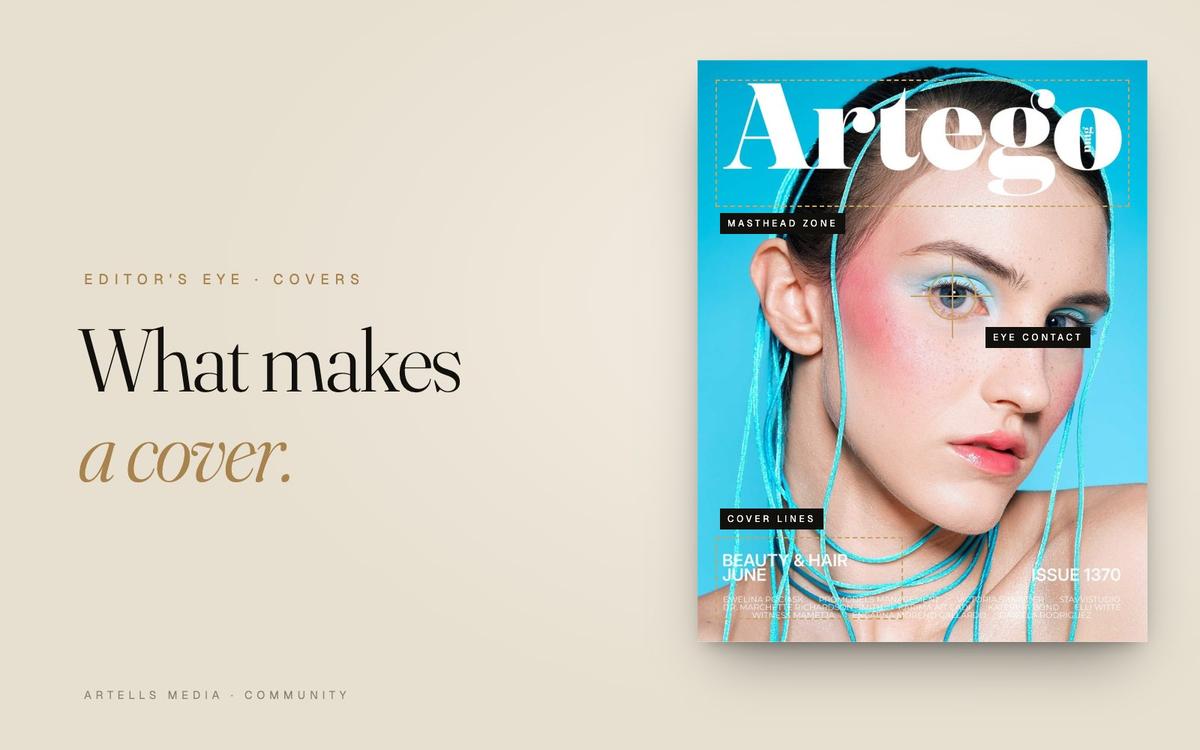
A direct gaze into the lens remains the classic cover move for fashion and portrait titles. Psychologists call it the eye contact effect: a face looking straight at us grabs attention faster than one looking away, and on a crowded shelf that half-second matters. It is a strong default with plenty of exceptions: art-led titles happily run profiles, closed eyes or no face at all when the idea is strong enough.
This detail quietly decides most covers. The magazine's name sits at the top, and cover lines (the short headlines) usually run down the sides. An image whose key detail lives in the top fifth of the frame will fight the masthead, and the masthead always wins. Leave calm space above the head and quiet areas at the sides: plain background, soft out-of-focus tones, sky, a wall. Hair slightly overlapping the masthead is a classic look that gives a cover depth. A forehead cut in half by the logo is not that look.
Vertical framing
A magazine cover is a portrait-format page. Horizontal photographs can sometimes be cropped into a cover, but the crop usually throws away what made them good. If you want a cover, shoot vertical frames on purpose.
Crop safety
Every printed page is trimmed after printing, and the trim is never perfectly exact. Printers ask for an image that runs past the edge of the page (the bleed, commonly about 3 mm or 1/8 inch on each side) and keep important elements a little inside it. Our Submission Rules also say the magazine "reserves the right to crop your photos and adjust their size for publication". In practice: leave air around your subject. Fingertips, the top of a hairstyle, the tip of a shoe touching the frame edge are the first things to disappear in layout.
Skin and retouching at print size
The cover is the most scrutinised page in the issue. Over-smoothed skin reads as plastic on paper, and a dust spot invisible on your phone becomes a feature. Check the file at 100% zoom, retouch with restraint, and keep texture in the skin.
Colour that stands out on a shelf and as a thumbnail
A cover competes twice: in print, next to other magazines, and online, as a square the size of a stamp. Simple colour blocks, strong tonal contrast and a clear silhouette survive both. Test it: shrink your frame to thumbnail size and convert it to black and white. If the face and shape still read instantly, you have a candidate. If it turns into grey soup, the colours were doing all the work.
Cohesion with the magazine and the issue
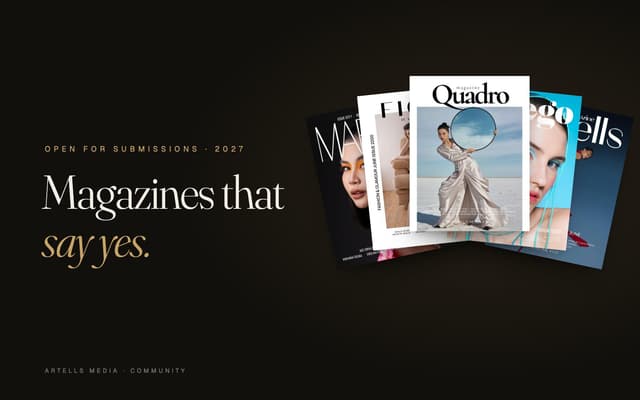
Finally, a cover has to belong to its title. Each of our five magazines has its own character: Artells reads the broadest range of work, Artego leans towards bold art direction and conceptual stories, Marika towards fashion, beauty and portrait, Figgi towards fresh faces and new names, and Quadro towards composition, geometry and visual rhythm. A cover that would be perfect for one can look lost on another.
Technical needs
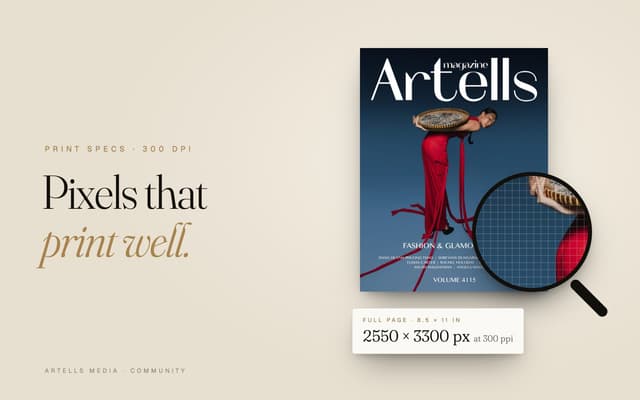
Start with the Submission Rules: JPG, sRGB, and for portrait format 8.5 × 11 inches at 300 dpi, which is 2550 × 3300 pixels, the full page. A full-bleed cover fills the entire page with no white border, so treat that as the minimum; a larger original with room around the subject is better. You don't need to add bleed yourself: the editors handle it in layout, and the print trim may take a little off the edges, so keep the face and hands away from them.
A few habits that save cover files:
- Send the original, uncropped, so the layout has room to move.
- Never upscale a small file to hit the pixel count. Print shows it.
- Export a fresh JPG from your master file rather than re-saving a compressed copy.
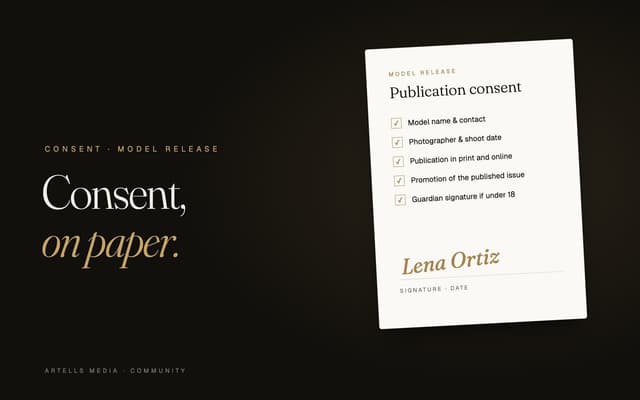
- Check releases. A cover shows a face at its largest and gets promoted widely, so the release should cover print, digital and promotion.
Why many great photos aren't covers
When editors pass on a photograph for the cover, the reason usually has nothing to do with quality:
- It is horizontal, and the crop kills it.
- The subject is small in the frame, so it disappears at thumbnail size.
- The key detail sits exactly where the masthead goes.
- The background is busy, so cover lines would be unreadable.
- Its power comes from the sequence around it, and alone it's quiet.
So if your favourite frame didn't become a cover, it may simply be an excellent page one, a different and equally honourable job.
How to shoot cover-ready frames during a series
You can't force a cover, but you can make sure one is in the set. Plan a short "cover pass" in your strongest setup:
- Switch to vertical and step back a little, or zoom out. Leave clean space above the head.
- Simplify the background for these frames, even if the rest of the series is busier.
- Shoot the gaze both ways: straight into the lens, and a variation looking off.
- Refresh hair and makeup first. The cover frame deserves the best five minutes of the day.
- Use an overlay. A transparent PNG with a masthead band and side columns, laid over a few frames on your laptop while you're still on set, can save a reshoot.
- Vary the expression and keep hands and hair away from the frame edges.
Then submit the series as a whole, cover frames included; the submission walk-through shows how.
There are two routes, and both still pass through the editors.
The Front Cover option. You can choose it right in the submission form. As the paid options page puts it, the cover is "reserved for your series once the editors approve it", and it is meant for a complete, cohesive series. If the editors decline, the payment is refunded in full within 5 to 10 business days. At the time of writing a front cover costs $290 at Marika and Quadro, $350 at Figgi, $749 at Artells and $790 at Artego. Artells and Figgi also offer a Digital Cover, the VIP Package adds a back cover and an AR (augmented-reality) cover, and Quadro offers a Personalized Edition, a full issue of your work. Paid options never influence editorial selection. Which frame becomes the cover is the editors' call. You can say which one you'd love to see there in About the series when you submit, and they will take it into account. There is no cover proof before print: the next time you see it, it's on the issue.
The Awards. Each month the Awards give away covers: Artells (plus a printed publication) for first place, Artego for second, and Figgi, Quadro or Marika, the winner's choice, for third. Entries are photographs only, judged blind on composition, light, concept, technical execution and fit with the theme. The top three get a prize code valid for 7 days: upload the full-resolution winning file (one photo is enough), pay nothing, skip the monthly limits, and the editors place it in an issue and tell you which. A horizontal winner can only become a cover by cropping it to the vertical format, so if a cover is the prize you're after, enter vertical photos.
Which is one more reason to enter your cover-ready vertical frames. Details are in how to enter the Awards.
Frequently asked questions
How do I get a magazine cover?
Shoot vertical, simple, strong frames with room for the masthead, and submit them inside a cohesive series. At Artells Media there are two routes: the paid Front Cover option, which is reserved for your series once the editors approve it and refunded in full if they decline, and the monthly Awards, where the top three places win covers of our magazines.
What makes a good magazine cover photo?
One clear subject, usually a face, that reads instantly even at thumbnail size. Calm space at the top for the magazine's name and at the sides for cover lines. Vertical framing with air around the subject so it survives trimming. Clean, restrained retouching that holds up at full print size, and a mood that fits the character of that particular magazine.
What resolution does a magazine cover need?
Print usually needs 300 dpi at the final size. For Artells Media magazines, the Submission Rules specify JPG in sRGB, portrait 8.5 × 11 inches at 300 dpi, which is 2550 × 3300 pixels. For a full-bleed cover treat that as the minimum. Send your original, uncropped file and never upscale a smaller one to reach the number.
Should the model look at the camera on a magazine cover?
Usually it helps. A direct gaze grabs attention quickly, which is why it is the classic choice for fashion and portrait covers. There are plenty of exceptions, though: art and concept-led covers often use profiles or closed eyes. On a cover shoot, capture both versions so the editors have a choice.
Can a horizontal photo become a magazine cover?
Sometimes, if the subject sits in a part of the frame that survives a vertical crop with space above it. More often the crop removes what made the photo work. Our Submission Rules let the magazine crop and resize images for publication, and that crop is the only way a horizontal frame reaches a cover (Awards winners included). The best way to be considered is to shoot vertical frames on purpose.
Can I pay for a magazine cover?
At Artells Media you can choose a paid Front Cover option in the submission form, but the cover is reserved only once the editors approve your series. If they decline, the payment is refunded in full within 5 to 10 business days. Paid options never influence editorial selection, and covers can also be won for free in the monthly Awards.
Somewhere in your last shoot there might be a cover hiding in plain sight. Go back through it with an editor's eyes, find the vertical frame with room to breathe, and send it our way, with a series around it or into this month's Awards. We'd love to see it on the shelf.
Comments
Sign in to join the conversation.
No comments yet. Be the first.