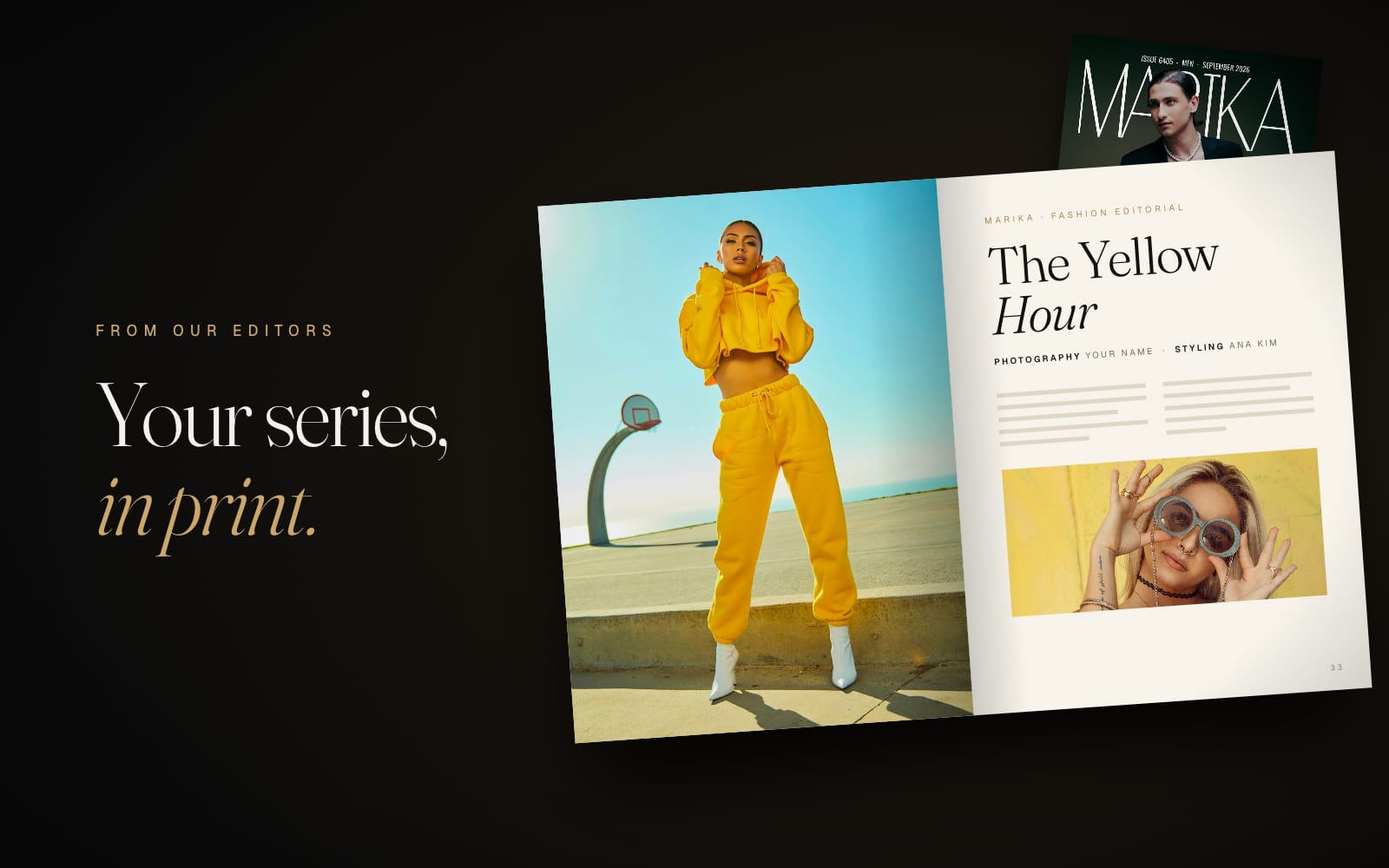
Every week our editors go through hundreds of submissions for Marika, Artells, Artego, Figgi and Quadro. Roughly half get declined, and almost always for the same handful of reasons. None of them have to do with talent. Here is what actually decides whether your work makes it into print.
What an editor sees in the first ten seconds
Before any single image is judged, an editor sees the series as a whole: does it hold together, does it look like a story, does it feel like it belongs in this magazine. That first impression decides whether the submission gets a careful look or a quick pass. Everything in this guide is really about winning those ten seconds, and then surviving the careful look that follows.
Start with a cohesive series, not your greatest hits
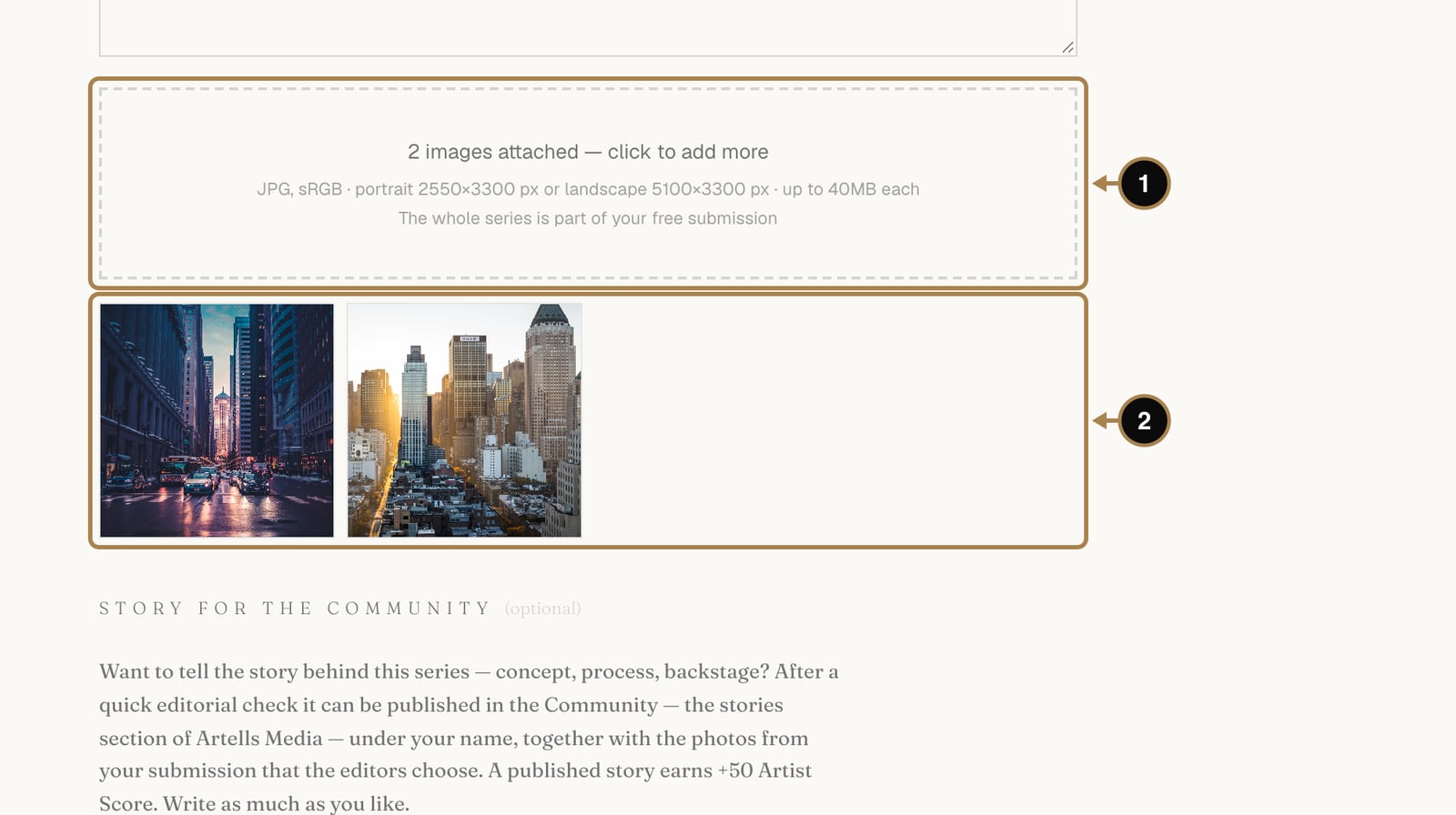
The most common mistake we see: a submission with one stunning beauty portrait, one street-style shot and one moody landscape. Each image might be strong on its own, but a magazine publishes stories, not folders. Pick 2 to 16 images from a single shoot: same concept, same styling, same light. An editor should be able to look at your series and imagine it as a spread.
A useful self-test before you submit: put the images side by side and ask whether a stranger would believe they were shot on the same day, by the same person, about the same idea. If the answer is no, split them into separate submissions. Two coherent small series beat one incoherent big one every time.
Pick the right magazine for the series
"Fashion magazine" is not one thing, and neither are our five titles. Sending a conceptual art series to a beauty-focused title wastes a slot; the same series in the right magazine sails through.
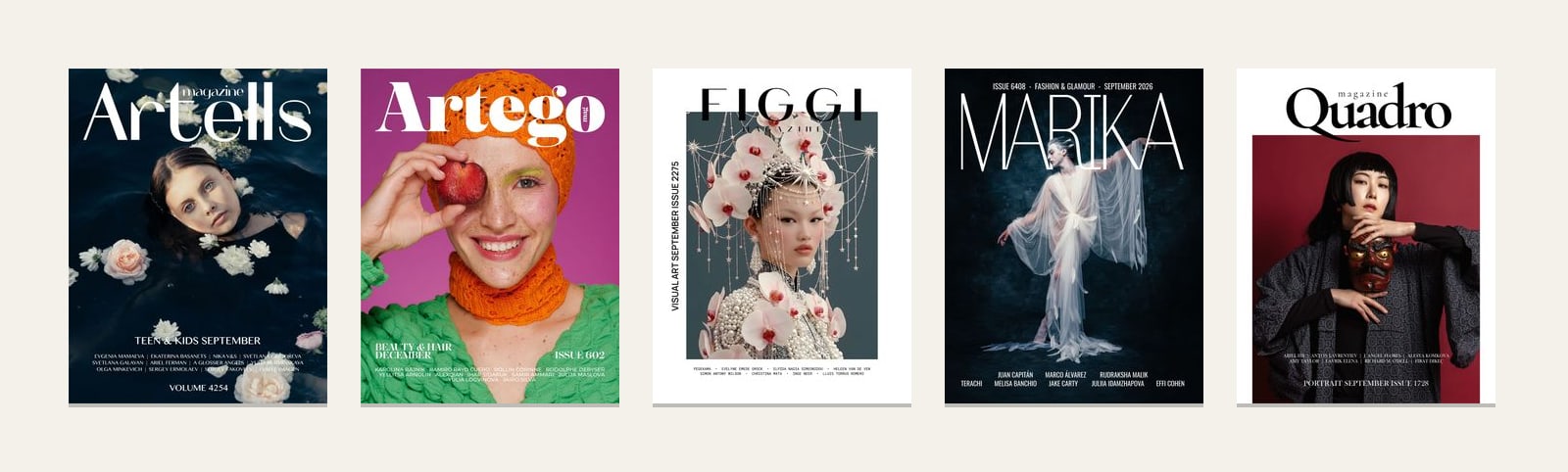
- Artells: the flagship. Editorial, beauty and fine-art photography.
- Artego: bold visual stories, art direction and conceptual work.
- Marika: fashion, beauty and portrait photography from around the world.
- Figgi: fresh faces and rising talent, the magazine where new names debut.
- Quadro: composition-driven photography. Form, geometry, visual rhythm.
Look through each magazine's page, see what the editors have been selecting, and submit where your series genuinely fits. Editors notice when someone has done that homework, and when they haven't.
Read the technical requirements before you shoot, not after
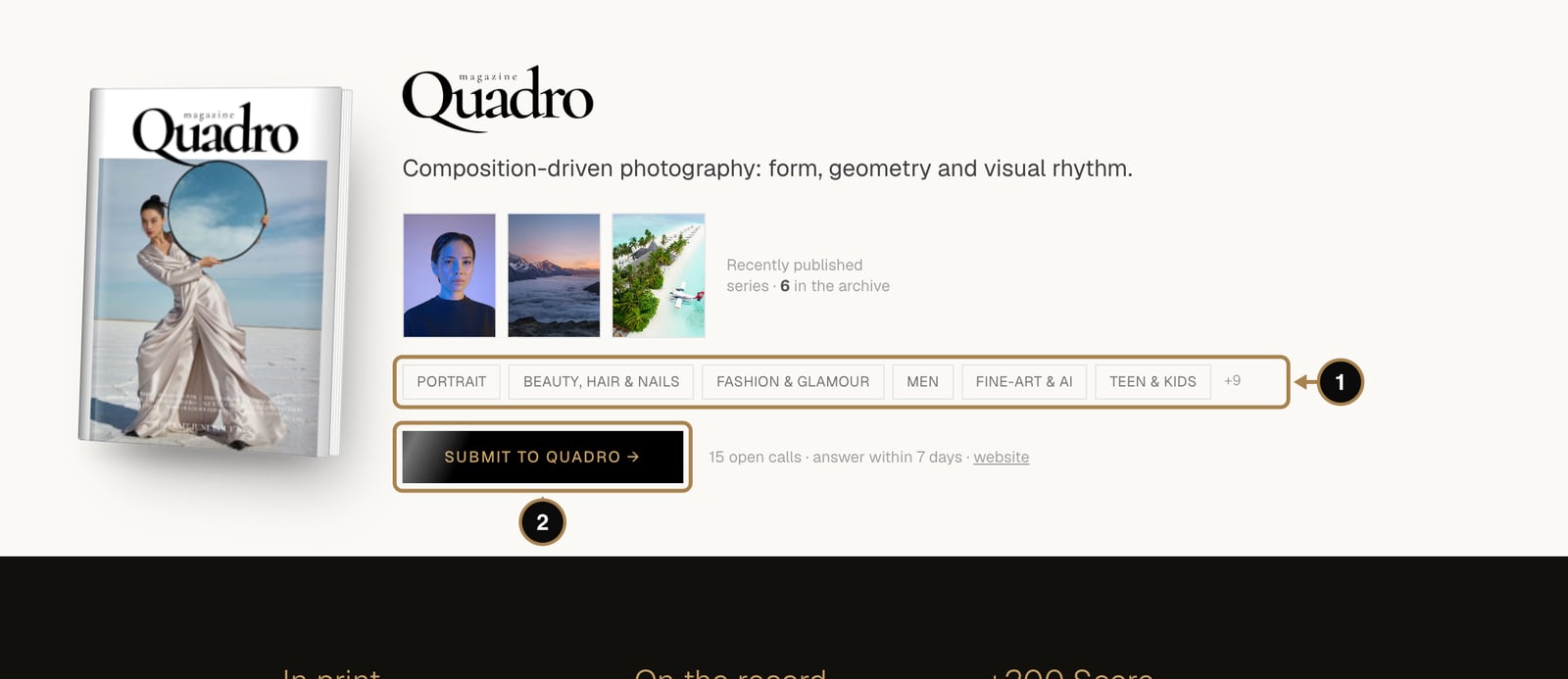
We ask for JPG, sRGB, and specific sizes: portrait 8.5×11 in at 300 dpi (2550×3300 px) or landscape 17×11 in (5100×3300 px). This isn't bureaucracy. Print is unforgiving. A file that looks fine on Instagram can fall apart on paper: compression artifacts bloom, shadows lose their detail, skin turns plastic. If you shoot with print sizes in mind, you'll never have to crop a good frame to death later.
Two habits that save submissions: keep your originals in full resolution (export a fresh JPG from the source, don't re-save a compressed one), and check your frames at 100% zoom before uploading. That's roughly how they'll be scrutinised in prepress.
Credits are part of the work
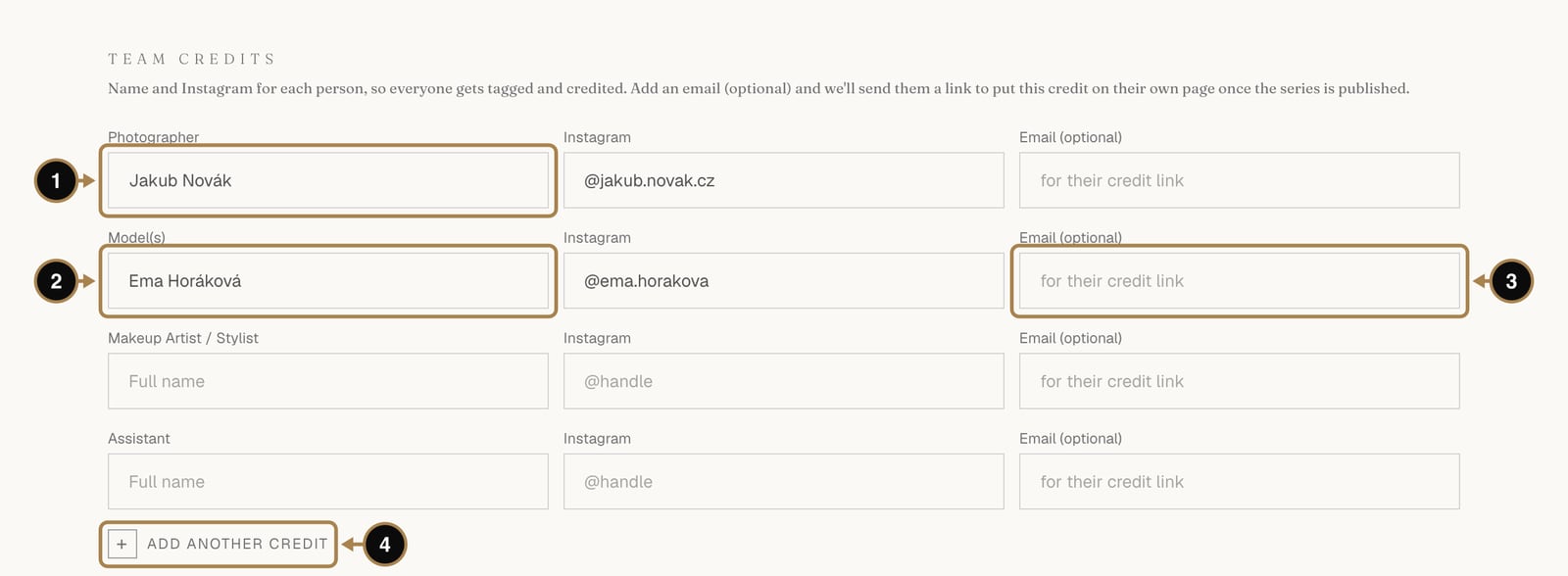
List everyone: photographer, model, makeup artist, hair stylist, wardrobe. If you did everything yourself, credit yourself and leave the rest empty. Wrong or missing credits are the number one reason for post-publication headaches, and editors know it. A clean credit list quietly tells us you're professional.
Credits also matter for the team you shot with. A published page credits five people, and each of them gets a tear sheet line for their book. Teams that credit properly get invited back; the industry is smaller than it looks.
Clear the rights before you submit
You need to own the copyright and have model releases from everyone recognizable in the frame. If a magazine can't be sure the rights are clean, it won't take the risk, no matter how good the photos are. The moment to sort this out is on set, when everyone is together and happy, and not months later, when the series is accepted and someone from the shoot has stopped answering messages.
You keep the copyright to your work; publication grants the magazine a licence to print and promote the series as part of the issue. The exact terms are in the publication agreement shown at submission.
What happens after you hit "submit"
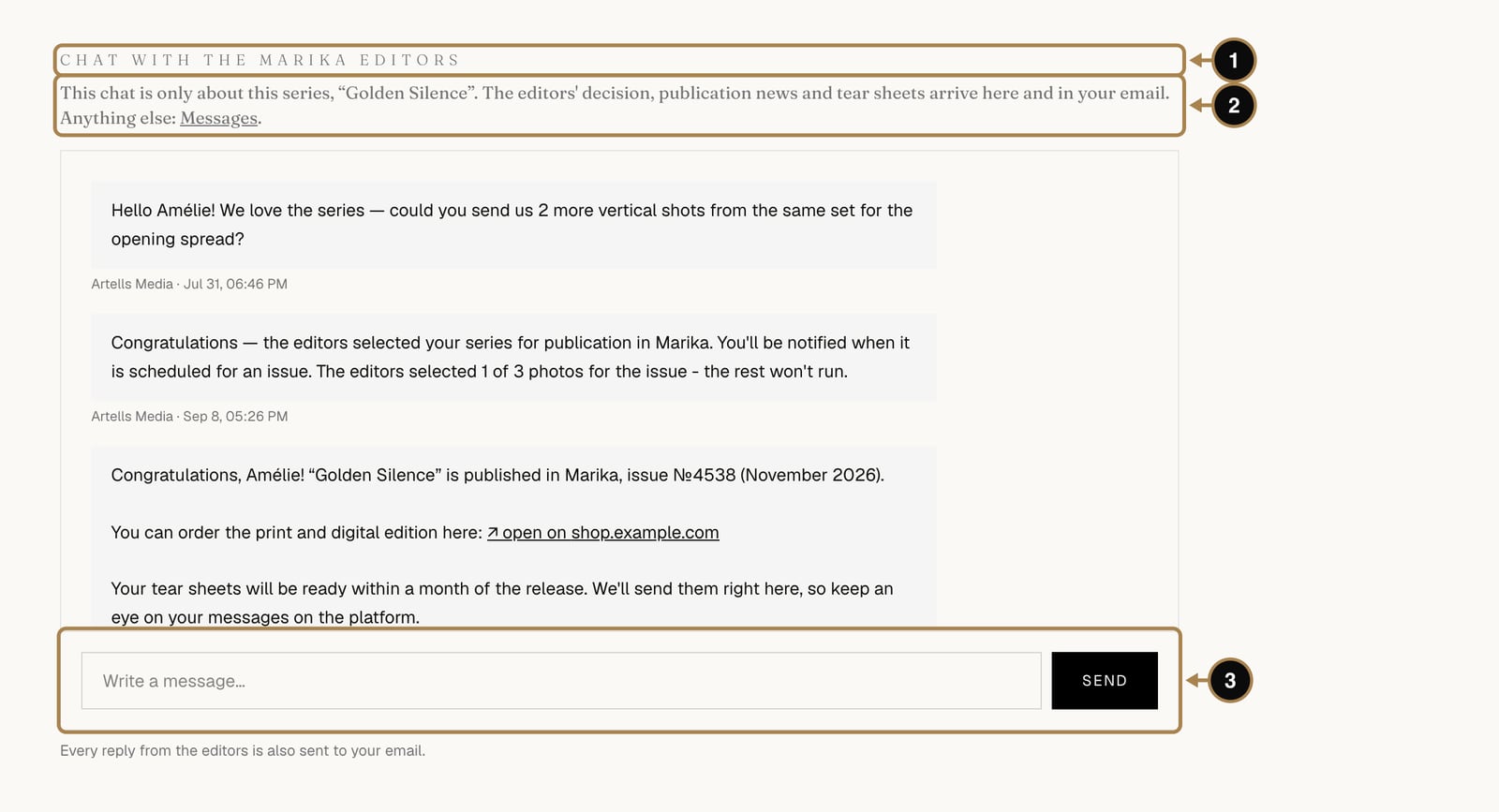
At Artells Media the editors answer within 7 days. If the series is approved, it's scheduled for the next issue, usually the following month. Publication on interior pages costs nothing. After release you can order a print or digital copy of the issue, and 30 days later you receive your tear sheets: the official pages with your work that go into your portfolio (here's why tear sheets matter more than any portfolio shot).
Every publication also grows your Artist Score, the public reputation number on your profile that agencies, clients and the editors themselves see. The full walk-through of the form, with a screenshot for every step, is in How to submit a series to a magazine.
While you wait, two more doors
A submission review takes days, an issue takes a month. Meanwhile the platform has two faster ways to get in front of the same editors:
- The Open Feed: a weekly themed open call. Upload to this week's theme; the editors browse the feed all week and mark selections for their magazines.
- The Awards: a monthly juried photo contest with a printed cover as the prize. Entering costs nothing.
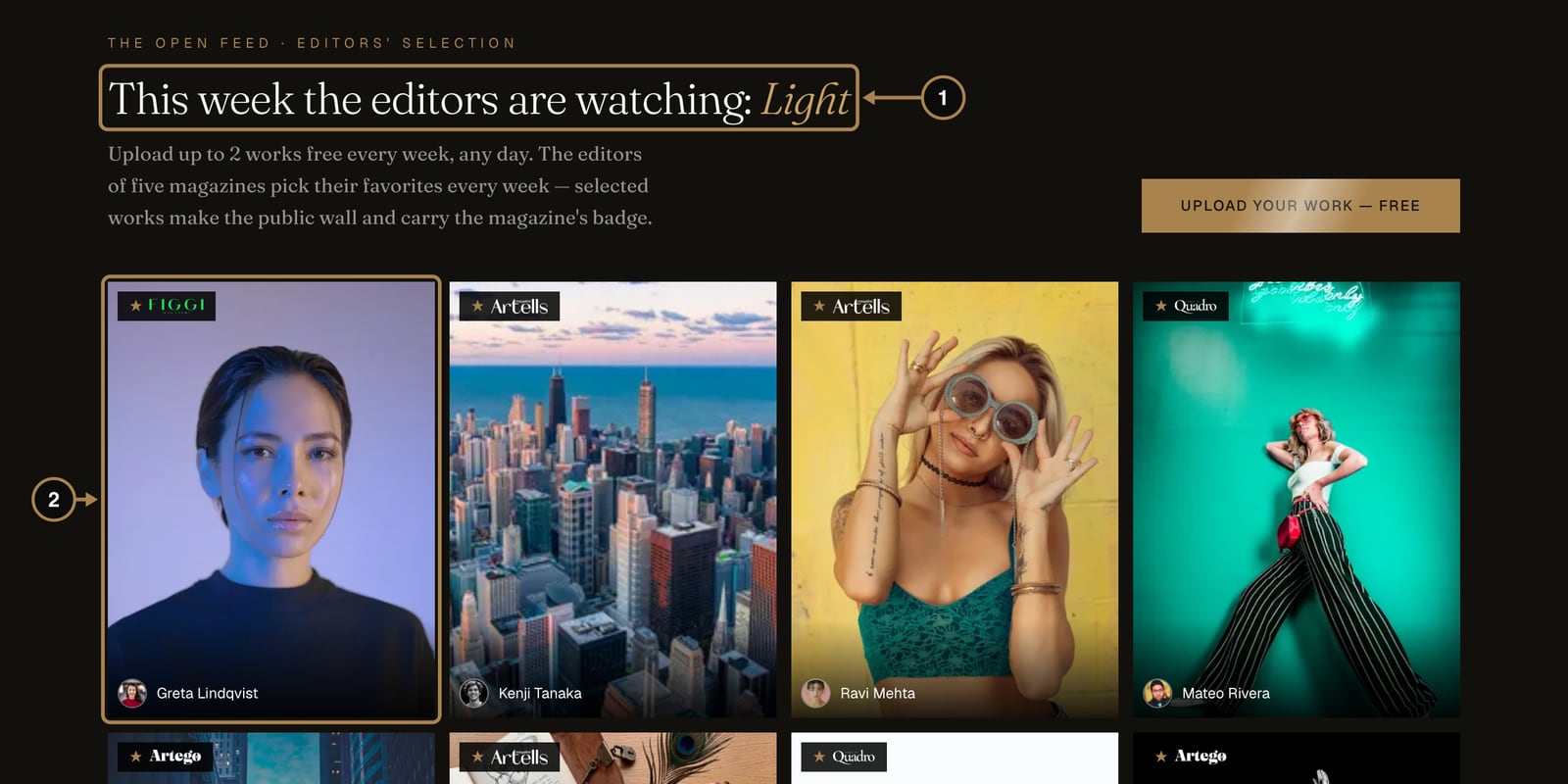
Both feed your Artist Score, and both have put authors on pages who first arrived "just to try".
If you get declined
It happens to everyone, including photographers who have shot for major titles. A decline is almost never "you're not good enough". It means "this particular series doesn't fit this particular issue". Submit a different project. Editors remember persistent authors, in a good way.
What not to do after a decline: don't resubmit the same series unchanged the next day, and don't take it out on the editors in the comments. What works: look at what the magazine has actually been publishing, shoot with that in mind, and come back. The authors we publish most are rarely the ones who were accepted first. They're the ones who came back second and third.
Frequently asked questions
Does publication cost anything? Interior-page publication costs nothing in all five magazines, and selection is editorial: the editors' yes cannot be bought. Paid editorial options exist for placements that are scarce by nature: covers, features, interviews.
How many images should I submit? 2 to 16 from a single shoot. Twelve strong, coherent frames beat sixteen where four are filler; editors feel padding instantly.
Can a model or makeup artist submit, or only the photographer? Any member of the team can submit, as long as the rights are cleared: the copyright holder (usually the photographer) has agreed, and model releases are in place. Credit the whole team either way.
How fast will I see my work in print? Editors answer within 7 days; approved series usually land in the following month's issue. Tear sheets arrive 30 days after release. From submission to pages-in-hand, plan for about two months.
Do I lose the rights to the photos? No, you keep the copyright. The magazine receives a licence to print and promote the series as part of the issue.
Ready to try? Choose your magazine and send your series: Marika, Artells, Figgi, Artego or Quadro. The submission takes about ten minutes.
Comments
Sign in to join the conversation.
No comments yet — be the first.