
Ask any modeling agency what separates a beginner's book from a professional one and you'll hear the same word: tear sheets.
The short definition
A tear sheet is a page of a printed magazine featuring your work. The name is literal: in the days when portfolios were physical books, you would buy two copies of the issue and carefully tear or cut your pages out of one of them. Today the term covers digital versions too: an official PDF of your published pages, provided by the magazine itself.

The key word in that definition is official. A tear sheet comes from the publication. A screenshot you made yourself, a mockup, a "magazine-style" layout from a template: none of these are tear sheets, and everyone who works with them professionally can tell the difference at a glance.
Why they carry more weight than a portfolio shot
Anyone can put a beautiful test shoot in a portfolio. A tear sheet is different: it proves an editorial team looked at your work and chose to print it. It's third-party validation. For a model it says "clients have already trusted this face". For a photographer, makeup artist or stylist it says "this person delivers work that magazines accept".
There's a second layer to it: print is a commitment. A magazine page costs the publisher money and cannot be quietly edited or deleted the way an online post can. When your work is on that page, someone decided it was worth the space. That's why one printed page routinely outweighs thousands of likes.
Who actually asks for them
- Modeling agencies. For many, tear sheets are the dividing line between "new face" and "working model", and scouts ask for them almost before anything else.
- Casting directors and brands. A book with editorial pages signals that a team of professionals has already worked with you and the result was publishable.
- Art buyers and photo editors. For photographers, published pages show you can deliver a story that survives layout, not just single frames.
- Immigration officers. Less obvious, but real: tear sheets are core documentation for talent visa petitions like the O-1 and Global Talent (more on that in our O-1 guide).
What a proper tear sheet looks like
It should show the actual magazine layout: your images on the page, with the issue's design, page furniture and credits, rather than just the raw photo. Ideally the set includes the cover of the issue, so anyone can verify where and when the publication happened.

When we send tear sheets at Artells Media, you get exactly that: your pages as they appear in the issue, together with the cover, 30 days after release. They arrive on the page of your published series, ready to download.
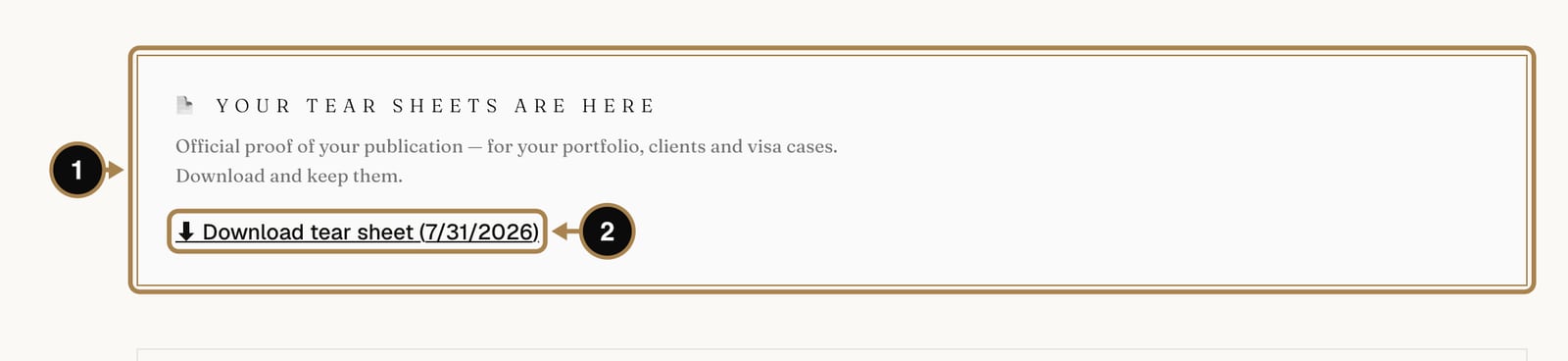
Each publication also has a public verification page on the platform, so an agency or a lawyer can confirm it in one click, without writing to anyone.

Print or digital: which do you need?
Both, ideally, because they do different jobs. The digital set lives in your online portfolio, your PDF book and your emails to agencies; it travels instantly. The printed issue is what you put on the table at a casting or a meeting: physical proof nobody can dismiss as "made in Photoshop". Our magazines are print-on-demand and ship worldwide, so you can order the physical issue whenever you need it, for yourself, for your agency, or as a gift for the team from the shoot.
How to earn your first one
The honest route is an editorial submission. Shoot a cohesive series, check the magazine's technical requirements, clear the model releases and submit. Interior-page publication in our magazines, Marika, Artells, Figgi, Artego, Quadro, costs nothing; the editors select works on merit and answer within 7 days. If your series is accepted, you'll have your first tear sheets a month after the issue comes out. The whole road, with screenshots, is in How to submit a series to a magazine.
There are two more doors on the platform, and both lead to the same place:
- The Open Feed: a weekly themed open call. You upload to the week's theme, and the editors browse the feed all week picking works for their magazines. It's the lowest-effort way to get seen: no forms, just your best frame on the theme.
- The Awards: a monthly juried contest where the prize is a printed cover. A cover tear sheet is the strongest page a book can open with.
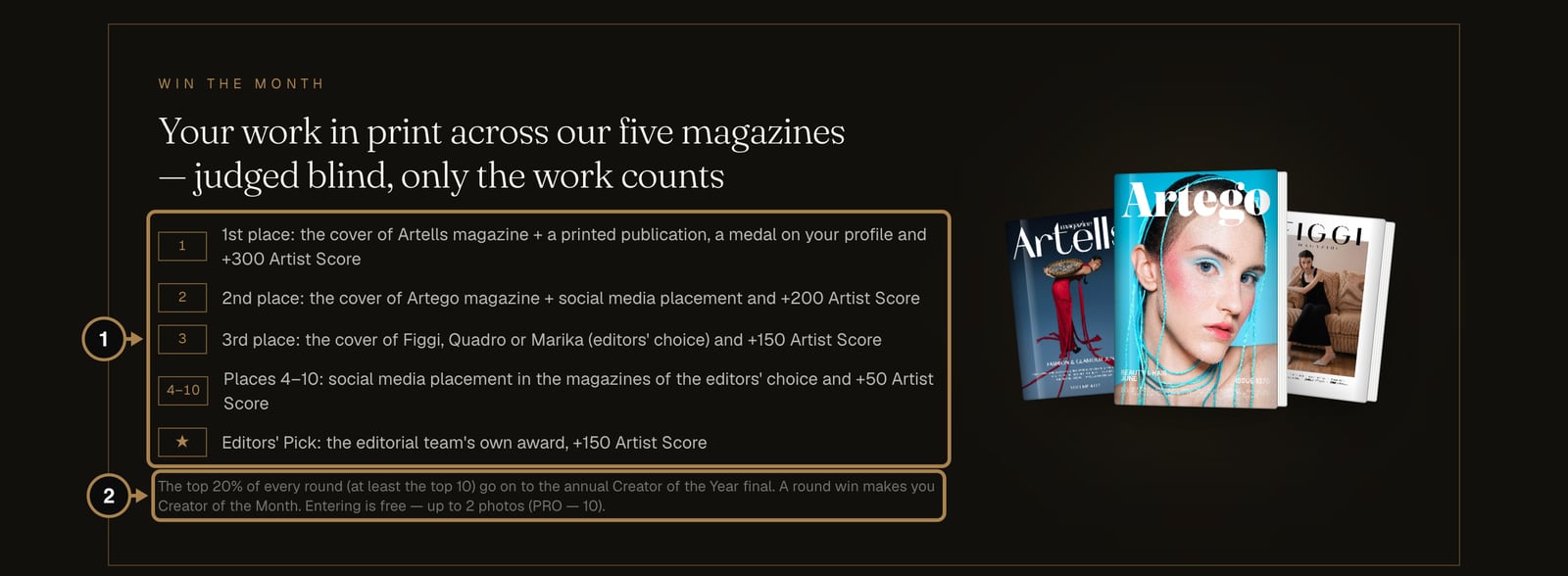
Whichever door you use, every selection and publication also grows your Artist Score, the public reputation number agencies and clients see on your profile.
How to present tear sheets once you have them
A few habits that make your pages work harder:
- Keep the source files of everything you publish. Agencies sometimes ask for high-res versions of the published frames.
- Note the magazine, issue and date for each publication and put that line in your CV exactly: Marika Magazine, September 2026. Vague "published internationally" reads as nothing.
- Spread your pages across different magazines rather than publishing five times in one. Variety reads as demand.
- Open your book with your strongest editorial, ahead of your strongest test shot. The first page sets how everything after it is read.
- Keep a folder with covers and dates. Future you, applying for a visa or a big contract, will be grateful.
Frequently asked questions
Can I make a tear sheet myself from a screenshot of the published page? No. A tear sheet is issued by the publication; that's the whole point. Screenshots and self-made "tears" are exactly what agencies have learned to distrust. If you were published, ask the magazine for official pages. At Artells Media they're sent to every published author automatically.
Are tear sheets the same as clippings? Close cousins. "Clippings" (or press clippings) usually mean any press mention cut from print: articles, reviews, news items. Tear sheets specifically mean pages featuring your creative work: the editorial you shot, modeled or styled.
Do I lose the rights to my photos when they're published? No. At Artells Media the author keeps the copyright; the magazine receives a licence to print and promote the series as part of the issue. The exact terms are in the publication agreement you accept when submitting.
How long until I receive my tear sheets? At Artells Media, 30 days after the issue is released. The delay exists because the issue sells first; the official pages follow once the release cycle is done.
Do digital-only publications give tear sheets? Some do, as PDFs. But pages from a printed issue carry more weight precisely because print is verifiable and permanent. If you have the choice, choose publications that exist on paper.
Ready to earn your first pages? Pick a magazine and submit your series: Marika, Artells, Figgi, Artego or Quadro. The editors answer within a week.
Comments
Sign in to join the conversation.
No comments yet — be the first.