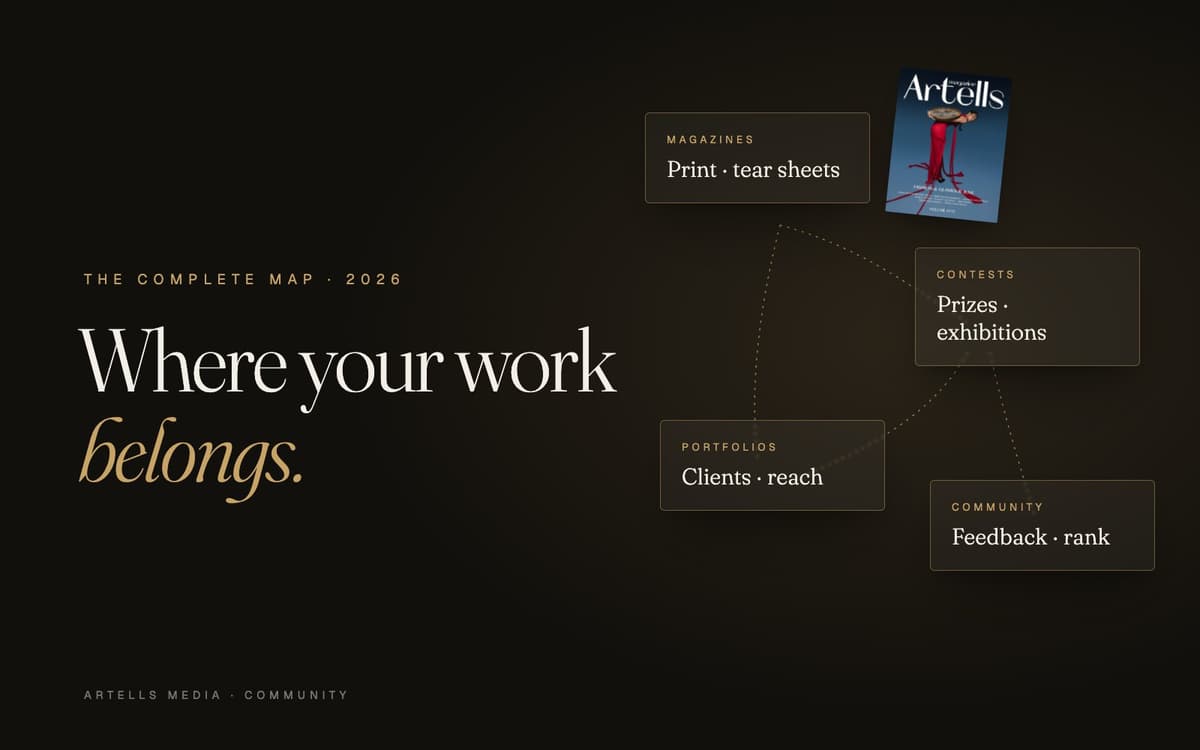
You finished a series you love. Now what? Post it and hope? Pay an entry fee and wait four months? Email a magazine and refresh your inbox like it owes you money?
This guide is for photographers first, and also for models, stylists, makeup artists, designers, illustrators and artists. It maps the main places to show work in 2026: magazine submission platforms, photo contests, portfolio and social platforms, and the old-school route of pitching editors. For each one you get its real strength, who it suits, how it charges, and one honest limitation.
We checked every service on its official site in early October 2026. Prices and deadlines change, so confirm on the official page before you pay anything.
A quick disclosure: this map is published by Artells Media, a platform run by five print magazines. We explain where we fit near the end, and we tried hard to be fair to everyone on the way there.
The quick map: choose by goal
Start with one question: what do you want this series to bring you?
- A print credit and tear sheets. Go to magazines: a marketplace such as Kavyar, direct pitches to editors, or a magazine platform like Artells Media. Contests rarely give you a printed editorial.
- Prize money. Go to the big contests: Sony World Photography Awards (free entry), IPA, LensCulture, Siena. Expect strong competition and long waits.
- Clients. Keep a portfolio always on: Behance, VSCO Hub, Dribbble or ArtStation depending on your field, plus Instagram.
- Community and feedback. 500px, GuruShots and 35AWARDS give fast reactions and rankings. Great for practice and momentum.
- Evidence for a visa or grant. Collect things a third party can check: printed publications, tear sheets, verified links, award results.
Most working creators mix three of these. The yearly plan below shows how.
Magazine submission platforms
Kavyar
A large submission marketplace where fashion, beauty and art magazines post "calls for work" and creators submit editorials with full team credits. Its directory lists hundreds of magazines taking submissions.
- Strength: choice and structure. Filter calls by medium and genre, credit your whole team on each image, and track everything in one dashboard. Kavyar says its publishers are vetted, and magazines can send tear sheets through the platform.
- Best for: fashion and beauty teams who shoot editorials often and want to place them across many titles.
- Cost model: each magazine sets its own options. According to Kavyar's help center, most offer a free option plus paid ones (such as faster review), and fees are charged whether or not the work is accepted. A PRO membership for submitters unlocks discounts on some calls. Since 14 December 2025, magazines need a paid Kavyar plan to accept new submissions.
- Limitation: quality, reach and print versus digital vary a lot between titles, and small fees add up if you submit widely. Read each call's exclusivity terms: some magazines hold exclusive rights for a set number of days after the call closes.
PhotoVogue
Condé Nast's photography and visual culture initiative connected to Vogue. Its main door for new artists is the yearly Global Open Call (hosted on Picter), plus regional open calls and the PhotoVogue Festival.
- Strength: prestige and a sharp curatorial eye. The 2026 Global Open Call, "Brave New Visions: Creativity as Rebellion", was free, awarded three grants totalling $12,000, and offered winners a festival presentation, possible publication across Vogue's global editions and portfolio reviews.
- Best for: photographers and video makers with a strong authored project, especially one with a social or cultural point of view.
- Cost model: the 2026 open calls were free.
- Limitation: it follows an open call calendar, so you cannot submit any month you like, and selection is extremely competitive. The 2026 global call has closed. AI-generated work is not eligible.
Picter (open call hub)
A submission and discovery platform that organisations use to run contests and open calls, with public listings of contests, grants, awards and exhibition opportunities.
- Strength: discovery. Picter says it runs calls for names like World Press Photo, Magnum, Vogue and Leica, so its listings are a quick way to see what is open now.
- Best for: photographers hunting grants, festivals and serious open calls.
- Cost model: set by each organiser; some calls are free, many charge fees.
- Limitation: every call has its own rules, rights and value, so you need to read each set of terms.
Pitching editors directly by email
Find a magazine whose pages already look like your work, read its guidelines, and send a short pitch: a few low-resolution images or a private gallery link, the story in two lines, full credits, and a note that the work is unpublished.
- Strength: it is free, and it builds real relationships. One editor who likes your eye can commission you for years.
- Best for: creators with a clear style, a target list, and patience.
- Limitation: silence is common, and rarely personal. Many titles only accept work through their own forms or a marketplace, and exclusivity rules mean one series goes to one place at a time. Our guide on how to submit a series to a magazine shows a pitch that respects an editor's time.
Photo contests and awards
Sony World Photography Awards
One of the best known photography competitions in the world, run by the World Photography Organisation. The 2027 edition is its 20th.
- Strength: free entry with serious prizes. Four competitions: Series, Single Image, Student, and Youth (19 and under). For 2027 you can enter both Series and Single Image with different work. Top prizes include up to $25,000 and a solo exhibition for Series and $5,000 for Single Image, plus Sony equipment and exhibitions in London and on tour.
- Best for: all levels, especially documentary, landscape and conceptual work.
- Cost model: free. Deadlines: Student 27 November 2026, Single Image and Youth 5 January 2027, Series 12 January 2027.
- Limitation: huge entry numbers and anonymous judging, so the odds are long. Strong single images and tight series do better here than fashion editorials.
International Photography Awards (IPA)
A long-running international competition connected to the Lucie Foundation, open to professional, non-professional and student photographers.
- Strength: prestige and a clear ladder. The top professional winner becomes International Photographer of the Year with a $10,000 cash prize; winners are exhibited and published in the IPA annual book. The 2026 winners celebration runs 8 to 11 October in Athens.
- Best for: professionals building an awards CV, and emerging photographers via Discovery of the Year.
- Cost model: paid entries. In the 2026 edition a single image cost $40 (professional), $30 (non-professional) or $20 (student), and a series $65, $55 or $35, with early bird and extra category discounts.
- Limitation: several categories get expensive, and with thousands of entries from well over a hundred countries, an honourable mention is a realistic target for most.
LensCulture Awards
A family of themed international awards (Black and White, Street, Portrait, Art, Critics' Choice and more) run by the LensCulture photography platform.
- Strength: accessible entry with real outcomes. Many 2026 awards offer a free single image entry, prize pools are typically around $10,000, top winners are exhibited in London, and paid written reviews are optional.
- Best for: fine art, street and portrait photographers who want international jurors to see their work.
- Cost model: one free single image on many awards; extra images and series are paid.
- Limitation: the free entry is one image, and several awards run at once, which can tempt you to spread your budget thin.
Siena International Photo Awards
An international competition and festival in Siena, Italy, run by Siena Awards alongside its Creative and Drone Photo Awards.
- Strength: festival exposure. Winning and finalist images are shown at the Siena Awards Photo Festival, running 10 October to 29 November 2026.
- Best for: single images with a strong story: travel, nature, documentary.
- Cost model: recent editions allowed one free image, with additional images paid. Confirm when the next edition opens.
- Limitation: one main deadline a year (the 2026 edition closed in January 2026), so plan ahead.
35AWARDS
An annual international photography award running since 2015, plus themed and express contests throughout the year. The 12th edition is under way.
- Strength: scale and transparency. Photos are judged anonymously over several stages, results are public, and the previous edition drew more than 112,000 photographers from 175 countries. Top entries reach the "100 best photos" ranking and the annual catalogue.
- Best for: amateur and advanced photographers who want regular, measurable feedback.
- Cost model: free within set limits; a paid account upgrade raises limits and opens premium contests.
- Limitation: strict technical rules (many contests ban borders and composites), and a ranking is great for motivation but usually weighs less with editors than a published editorial.
GuruShots
A photography game with hundreds of themed challenges a month, where players vote on each other's photos and level up toward the title of Guru.
- Strength: fun and a steady stream of votes. Challenges last from a day to about ten days, and selected photos can go into GuruShots exhibitions.
- Best for: hobbyists and learners who enjoy a game loop.
- Cost model: free to play, with in-app purchases such as boosts, swaps, keys and exhibition applications.
- Limitation: quick votes reward instant impact, which is not always what an editor or client would pick.
Portfolio and social platforms
Behance
Adobe's showcase platform for creative work, with a job board and freelance tools.
- Strength: breadth and client traffic across design, illustration, photography and more. A free account lets you publish projects, offer services and receive proposals.
- Best for: designers, illustrators, art directors and commercial photographers.
- Cost model: free, with Behance Pro (US$11.99 per month when we checked) removing platform fees and adding analytics and Adobe Portfolio sites.
- Limitation: it is enormous, so a new profile stays quiet until you publish regularly with full case studies.
500px
One of the oldest photo communities online, with Quests (photo challenges) and licensing.
- Strength: a photographer-first culture. 500px bans AI-generated images from profiles, Quests and Licensing.
- Best for: landscape, travel and nature photographers.
- Cost model: free accounts have a monthly upload limit; paid memberships remove it and add stats. Contributing to Licensing is free.
- Limitation: strong with photography fans, lighter on fashion and editorial clients.
Still the default visual business card for photographers, models and stylists.
- Strength: reach and direct contact; clients, casting directors and editors all check it.
- Best for: everyone, as a living portfolio.
- Cost model: free.
- Limitation: it is a feed you rent. Reach swings with the algorithm, and likes are not tear sheets.
VSCO
A photo editing app and community with VSCO Hub, a directory where businesses search for photographers to hire.
- Strength: a direct path to paid work: businesses search by style, location and experience and contact you.
- Best for: lifestyle, product and portrait photographers chasing brand clients.
- Cost model: free app tier; a VSCO Hub listing requires VSCO Pro, from $12.99 per month.
- Limitation: visibility is tied to the paid plan, and the focus is commercial work over editorial prestige.
Dribbble and ArtStation (designers and illustrators)
Dribbble is the classic showcase for UI, product and brand designers. Profiles are free; paid Pro plans add search visibility, client proposals and lower fees. Ideal for freelance designers, less useful for photographers.
ArtStation is home to game, film and concept artists. A free account includes a portfolio, the jobs board, print and digital sales and challenges; Plus and Pro add control and better earnings. A fashion photographer will feel like a guest there.
Comparison table
Facts checked on official sites on 4 October 2026. "Print" means a printed outcome you can hold or exhibit.
| Service | Type | Best for | Cost model | Print? | Free entry option? |
|---|---|---|---|---|---|
| Kavyar | Magazine submission marketplace | Fashion and beauty editorial teams | Each magazine sets free and paid options; optional PRO | Depends on the magazine | Yes, on most calls |
| PhotoVogue | Open calls and festival | Authored photo and video projects | Free open calls (2026) | Possible Vogue publication if selected | Yes |
| Picter | Open call hub | Grants, festivals, contests | Set by each organiser | Depends on the call | Some calls |
| Direct pitch | Email or magazine forms | Creators with a clear style | Free | Depends on the magazine | Yes |
| Sony World Photography Awards | Contest | All levels | Free | Exhibitions for winners | Yes |
| IPA | Contest | Professionals building an awards CV | Paid per image or series | Annual book and exhibitions | No |
| LensCulture Awards | Contest | Fine art, street, portrait | One free image on many awards; series paid | Exhibition for top winners | Yes (one image) |
| Siena International Photo Awards | Contest and festival | Story-driven single images | One free image in recent editions; more paid | Festival exhibition | Yes (one image) |
| 35AWARDS | Contest and rankings | Amateur and advanced photographers | Free within limits; paid upgrade | Annual catalogue | Yes |
| GuruShots | Photo game | Hobbyists, fast feedback | Free with in-app purchases | Exhibitions (paid applications) | Yes |
| Behance | Portfolio and jobs | Designers, commercial photographers | Free; Pro subscription | No | Free profile |
| 500px | Community and licensing | Landscape, travel, nature | Free with upload limit; paid tiers | No | Free account |
| Social | Everyone | Free | No | Free account | |
| VSCO Hub | Community and hiring | Lifestyle and brand photographers | Hub listing needs Pro | No | Free app; Hub is paid |
| Dribbble | Portfolio | UI and brand designers | Free; Pro tiers | No | Free profile |
| ArtStation | Portfolio, jobs, shop | Concept, game and film artists | Free; Plus and Pro | Print sales of your art | Free account |
| Artells Media | Feed, five print magazines, monthly awards, community | Visual creators who want print plus reputation | Free submissions, feed and awards; optional paid upgrades | Yes, printed issues shipped worldwide | Yes |
How to combine them: a yearly plan
Nobody needs all seventeen. Pick one tool per layer and give each a rhythm.
Every week: portfolio. Keep Instagram plus one field-specific platform current (Behance, VSCO, Dribbble or ArtStation). Post finished work, credit your team, pin your best published pieces. A few well-lit pieces beat a crowded shelf.
Every month: magazines. Plan one series a month with publication in mind, and pick the outlet before the shoot, since exclusivity usually means one series, one magazine. Save every tear sheet and link in one folder from day one.
Every season: contests. Contest season clusters in autumn and winter. Going by 2026 to 2027 timing: Sony's Student deadline falls in late November and its Single Image and Series deadlines in early January; Siena's main contest has opened in October and closed in January; IPA has run an early bird deadline in January and a final one in summer; PhotoVogue's global call has run from spring into autumn; LensCulture runs themed awards all year. Choose two or three contests that fit your genre and budget, and send your strongest edit while the rest of the hard drive stays home.
All year: community. Pick one place where you give feedback as well as receive it: a 500px Quest, a 35AWARDS themed contest, or a creator community. It keeps you shooting between big moments.
Once a year: paperwork. Gather credits, awards and verified links into one document. If a visa, residency or grant is on your horizon, start this file now. Future you will send a thank you note.
Where Artells Media fits
Artells Media is the platform behind five international print magazines (Marika, Artells, Artego, Figgi and Quadro) published since 2019. We know of no other place that combines a weekly feed, a monthly contest, print magazines, tear sheets and a reputation score under one roof. In practice:
- Submit to five print magazines for free. Send a series to any of our five magazines, for example Artego, and editors answer within 7 days. Every month you get three free tries at each magazine (six with PRO), and a declined series simply frees the next try. Accepted work appears in real printed issues, produced on demand and shipped worldwide.
- Get proof that holds up. Published creators receive tear sheets and verified publication links anyone can check. Creators use them as evidence, for example in O-1 visa petitions. We publish magazines and give no legal advice, so talk to an immigration lawyer about your own case.
- Show work every week. The Open Feed has a weekly theme, and editors of all five magazines pick favourites from it: a low-pressure way to get in front of editors between submissions.
- Enter monthly Awards for free. In the Artells Media Awards the community rates entries and the prize is a printed magazine cover. Cash would be nice too, but a cover looks better on a wall.
- Write and connect. The Community is where creators share stories, behind-the-scenes notes and lessons from shoots.
- Build a reputation clients can see. Your activity grows your Creator Score, which ranks creators and brings commissions from clients.
Optional paid upgrades exist for creators who want speed or extra visibility: priority review, features, covers, and PRO membership at $59 per month, or $49 per month billed yearly. The core stays free.
Honest limitations. The magazines date back to 2019, but the platform is younger, so the community is still growing. Editors curate every issue, so not every series is accepted. And the Awards prize is a cover, so if this year's goal is cash, the big contests above are the better tool. Plenty of creators use both.
New here? Start with how it works.
Frequently asked questions
Where can I submit photography in 2026?
You have four main routes: magazine submission platforms (Kavyar, Artells Media), direct pitches to magazine editors, contests and open calls (Sony World Photography Awards, IPA, LensCulture, Siena, 35AWARDS, PhotoVogue's open calls), and portfolio platforms (Instagram, Behance, 500px, VSCO). Choose by goal: magazines for print credits and tear sheets, contests for prizes, portfolios for clients. Most creators combine one of each.
How do I get my photos published in a magazine?
Pick magazines whose pages already look like your work, read their guidelines, and submit one cohesive series with full team credits. Check whether the magazine wants unpublished or exclusive work, and never send the same series to two places at once. Submit through the magazine's own platform, a marketplace, or a short email pitch. Track every submission and keep shooting while you wait.
What is a good Kavyar alternative?
It depends on what you need. For many magazines in one dashboard, Kavyar is hard to beat on choice. For free submissions to print magazines with a set reply time, Artells Media offers five print titles, three free tries a month at each, with editors answering within 7 days, plus a weekly feed, monthly awards and verified publication links. Pitching editors directly by email is the free, slower alternative.
Which photo contests are free to enter in 2026?
The Sony World Photography Awards are free, with 2027 deadlines in November 2026 and January 2027. PhotoVogue's 2026 open calls were free. Many LensCulture awards offer one free single image, and Siena has allowed one free image in recent editions. 35AWARDS has free participation within limits, and the Artells Media Awards are free every month. Always confirm current terms on the official site.
Are paid photo contests worth the entry fee?
They can be, if the contest is well known in your genre, the jury is named, and winning brings exhibitions or publication you value. Set a yearly contest budget, enter only your strongest work, and read the rights terms so you know how organisers may use your images. Early in your career, start with free entries and free magazine submissions before paying.
Do magazine publications count as evidence for an O-1 visa?
Published work in recognised media can be part of the evidence for extraordinary ability, alongside awards, press coverage and expert letters. What matters is proof: tear sheets, issue details and links an officer can verify. Artells Media provides tear sheets and verified publication links for exactly this reason. Your immigration lawyer decides how to present them, so ask early.
Should I post my series on Instagram before submitting it to a magazine?
Usually wait. Many magazines ask for unpublished work, and some hold exclusivity for a period after publication. A teaser or a behind-the-scenes clip is often fine, but check each magazine's rules first. Once the series is published, share it everywhere and tag the magazine and your team. That is when Instagram works hardest for you.
Information about third-party services was checked on their official sites on 4 October 2026. Brand names belong to their owners and are used only to identify their services. Prices, deadlines and rules change, so confirm on each official site before entering.
Comments
Sign in to join the conversation.
No comments yet. Be the first.