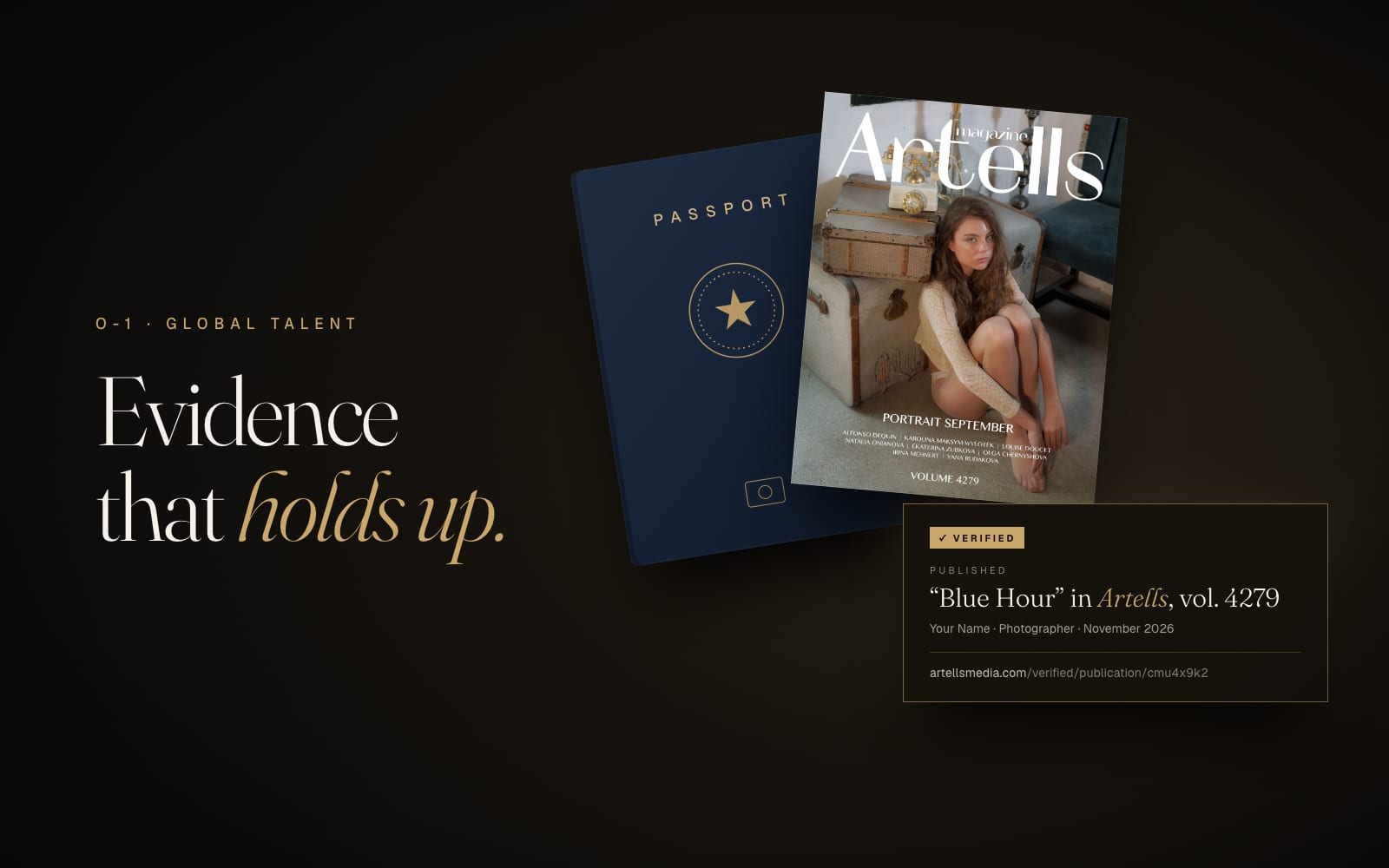
If you're a photographer, model, makeup artist or designer preparing an O-1 (USA) or Global Talent (UK) petition, your lawyer has probably already told you: you need published material. Here's what that means in practice, from a publisher that regularly works with visa applicants.
One thing before we start: this is a publisher's guide, not legal advice. Every petition is different, and the person who decides which evidence your case needs is your immigration lawyer. What we can explain is the part we know from the inside: what makes a magazine publication strong evidence, and what makes it useless.
Why publications matter for the petition
Both visa categories ask you to prove "extraordinary ability" with documented evidence. Among the criteria adjudicators look at: published material about you or your work in professional or major media, and evidence that your work has been displayed or showcased. Magazine features tick these boxes in a way screenshots of your Instagram never will: a printed, dated, verifiable publication with your name in the credits.
There's also a quieter reason lawyers like magazine evidence: it's one of the few criteria you can actually plan for. Awards depend on juries, press coverage depends on journalists, but a strong editorial submission is in your hands. You can shoot it, submit it and document it on a schedule that fits your filing date.
What adjudicators actually check
Three things make a publication useful as evidence.
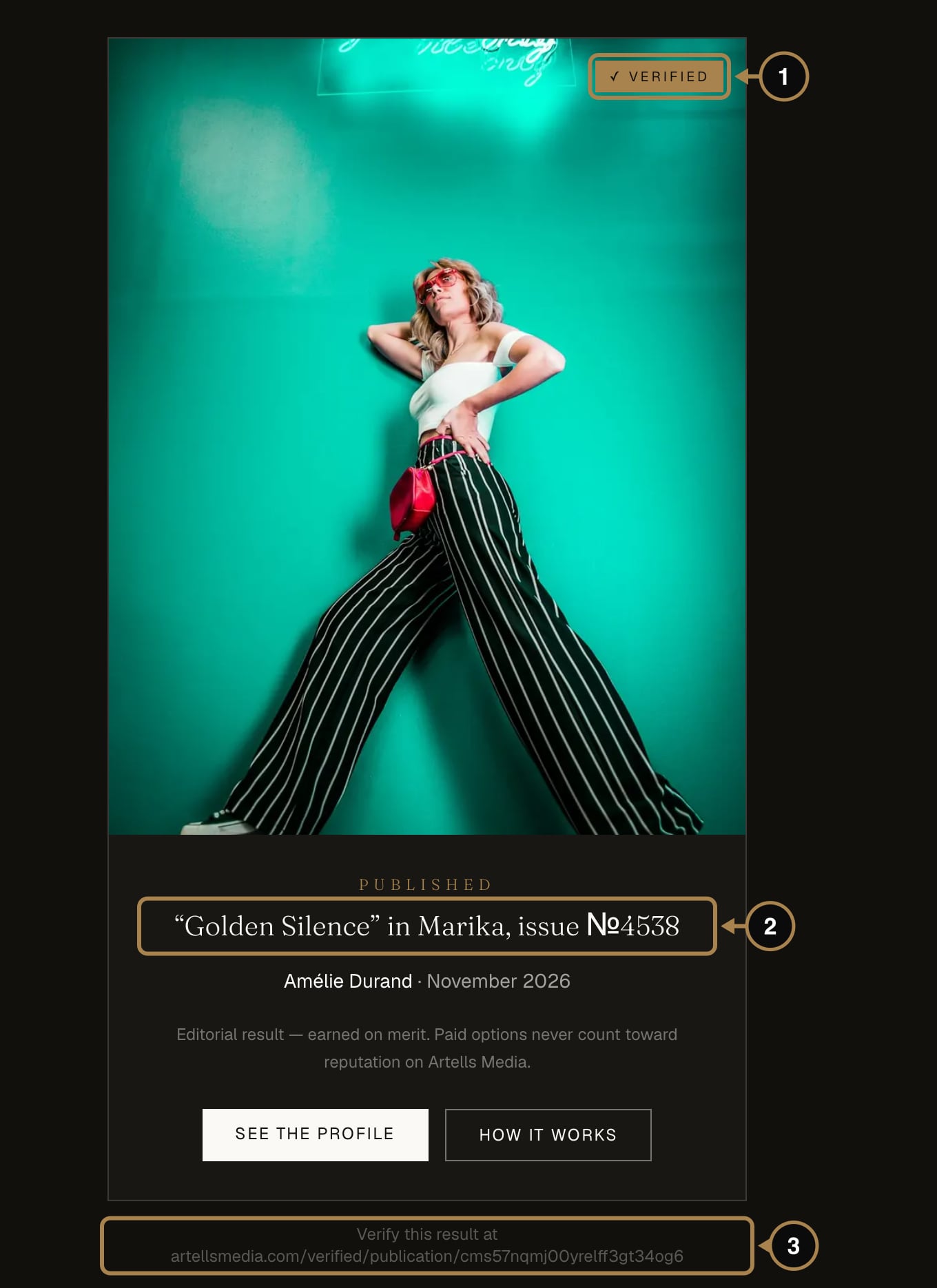
Verifiability. The magazine must really exist and be checkable by a stranger: a printed issue anyone can order, a working website, a named editorial team, real distribution. An officer who cannot confirm the publication exists will simply not weigh it. This is why "publications" that live only as a JPEG in someone's portfolio are worthless as evidence: there is nothing to verify.
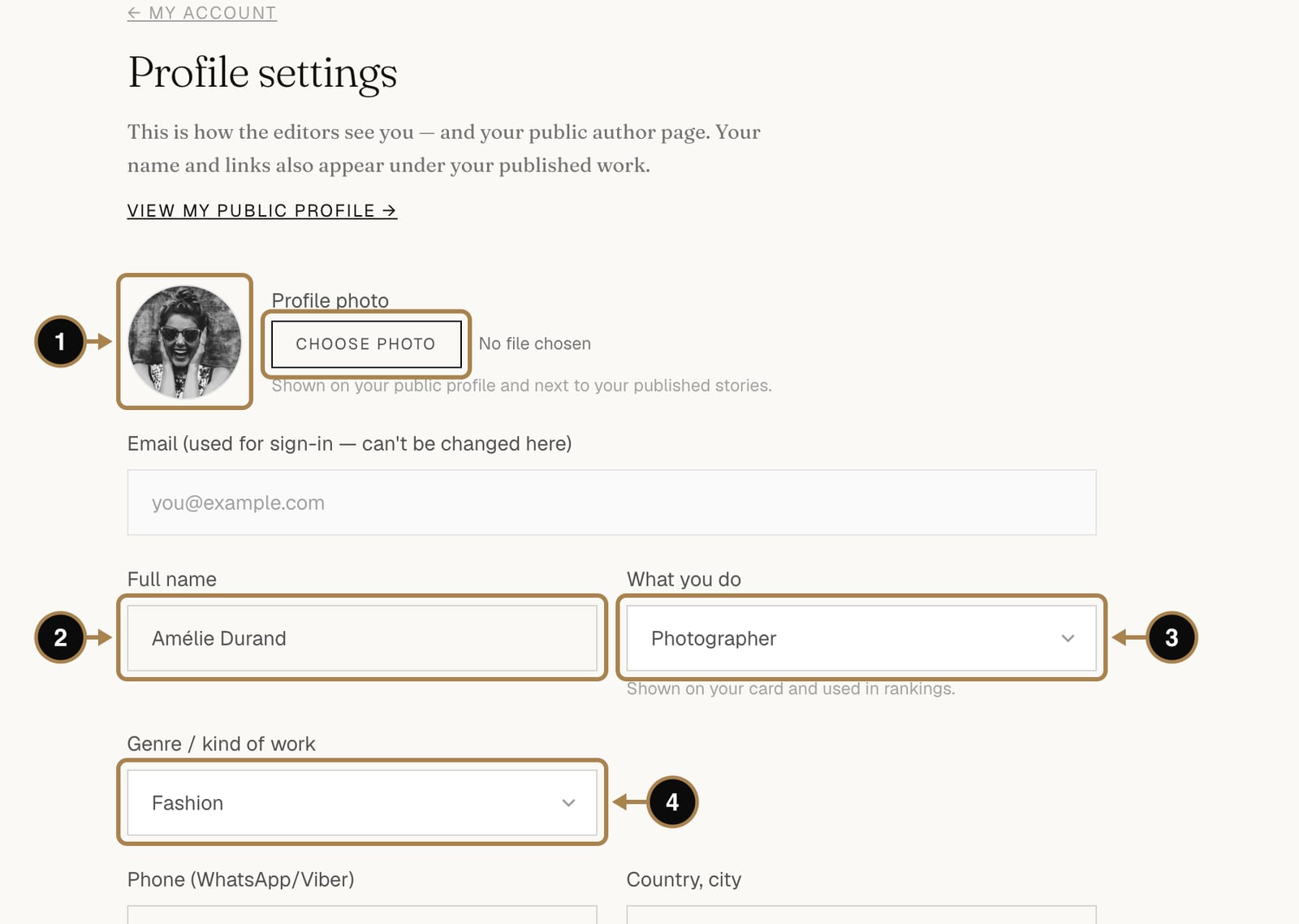
Attribution. Your name has to appear clearly in the credits or the feature, spelled exactly as it appears in your passport and petition. This sounds obvious, but it's the single most common problem we see: the work is published under a nickname, a studio name or a shortened first name, and the lawyer then has to build a chain of affidavits proving that "Kat V." and the petitioner are the same person. Decide how your name appears in print before you submit, not after, in your profile settings.
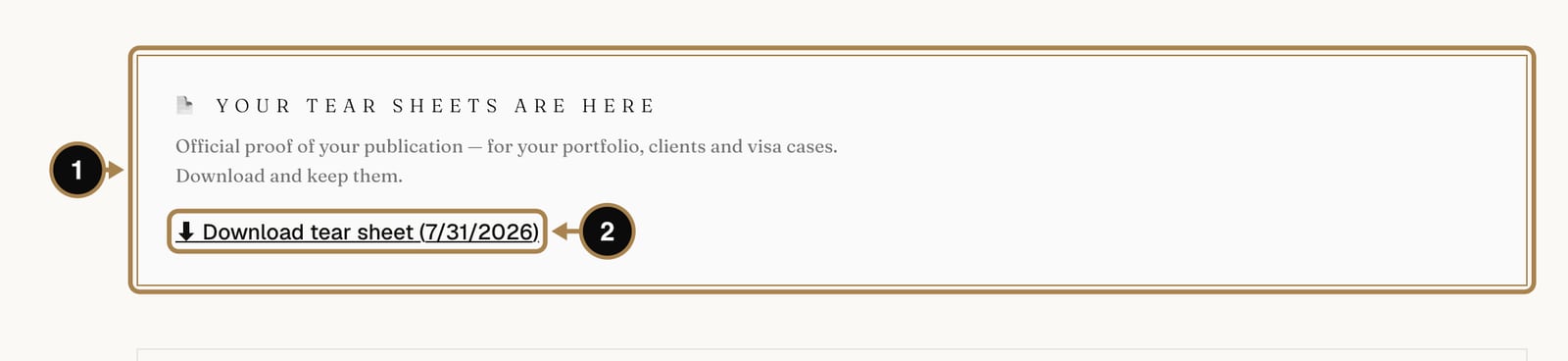
Documentation. You'll need the pages themselves (tear sheets), the cover of the issue, the issue date, and ideally a distribution reference. Collect these as you go. Reconstructing them a year later, when the issue has sold out and the magazine has moved on, is much harder.
"About you" beats "by you"
A feature or interview is stronger than a simple credit line, because the material is about you, not just by you. A published series shows your work was selected; an interview shows the magazine considered you, the artist, worth its readers' attention. These are two different angles of evidence, and adjudicators read them differently.
If you can get both, a published series plus an interview in the same or another issue, you cover both angles. Many of our authors plan it exactly this way: the series goes through the regular editorial selection, and the interview or feature is arranged as a separate editorial option.
The paper trail: what to keep
Build a folder from day one. For every publication it should hold:
- the official tear sheets, your pages exactly as they appear in the issue;
- the cover of that issue, with the issue name and date visible;
- a link that proves the publication exists. At Artells Media every published author, contest result and selection has a public verification page that anyone, including an immigration officer, can open without a password;
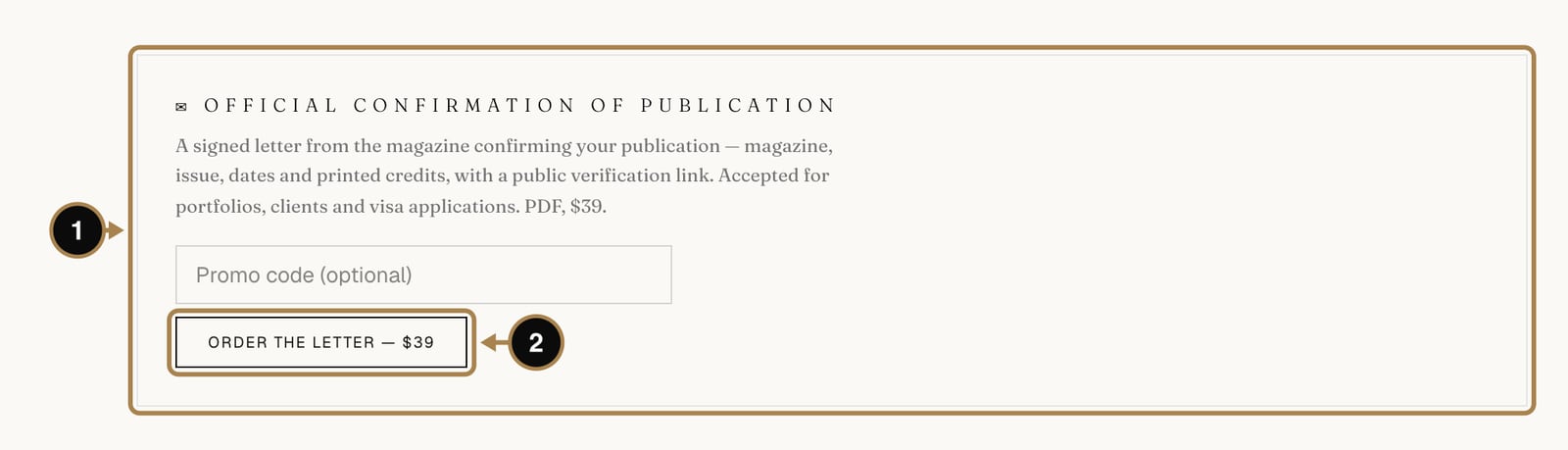
- a confirmation letter from the publisher, if your lawyer asks for one. We issue official confirmation letters for published authors as a paid document, stamped with the details lawyers ask about: what was published, where, and when;
- your own high-resolution files of the series, in case the lawyer wants to include the work itself.
Plan backwards from your filing date
Petitions routinely take months to assemble, and magazines work on monthly cycles. Count backwards: if your lawyer wants the evidence folder complete by, say, May, the issue needs to be out by March at the latest, which means the series should be submitted around the New Year. At Artells Media the editors answer submissions within 7 days, and approved series are scheduled for an upcoming issue, usually the following month; official tear sheets follow 30 days after release. That is fast by industry standards, but it is still a pipeline measured in weeks, not days. Start early.
What weakens a petition
A few patterns we've watched cause problems, so you can avoid them:
- Unverifiable publications. Blogs with no editorial selection, "magazines" that exist only as an Instagram page, mockups that were never printed. One real, checkable publication outweighs ten of these.
- Screenshots instead of documents. A phone screenshot of a page is not a tear sheet. Officers have seen thousands of doctored images; official pages from the publisher are a different category of evidence.
- Inconsistent names. Covered above, but it bears repeating, because it's cheap to prevent and expensive to fix.
- Everything in one place. A portfolio of publications spread across different titles and dates reads as sustained recognition. Five features in one issue of one magazine reads as one event.
Where Artells Media fits
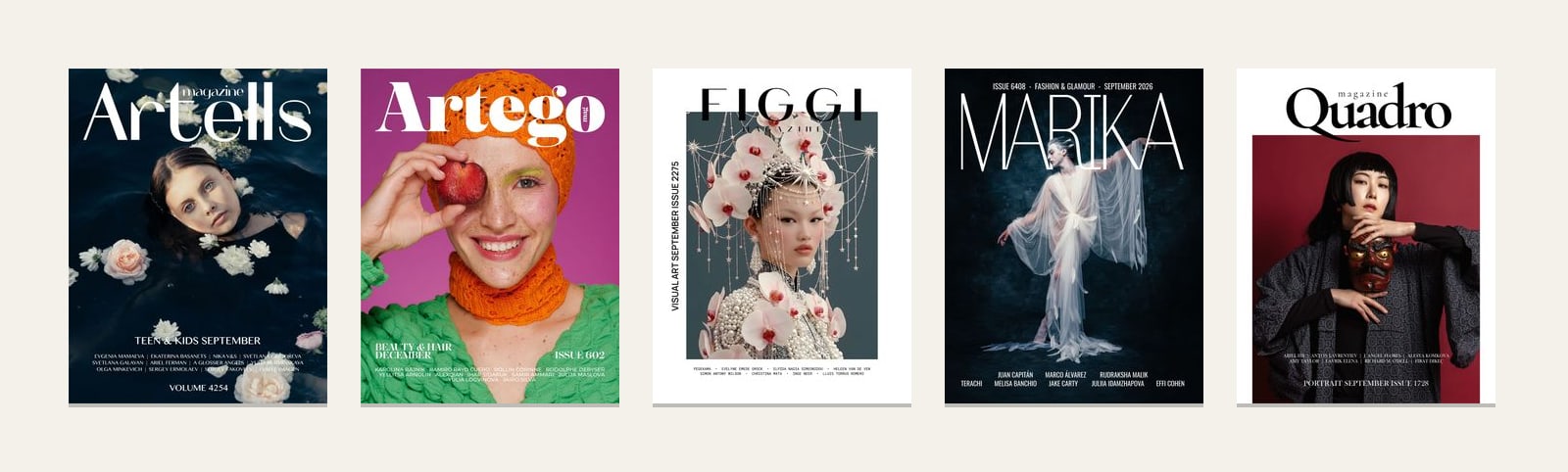
We publish five international magazines, Marika, Artells, Figgi, Artego and Quadro, distributed in print and digitally worldwide. Interior-page publication costs nothing and is editorially selected; the editors answer within 7 days. Every published author receives official tear sheets 30 days after release, every achievement has a public verification page, and confirmation letters for lawyers are available on request. Interviews and cover features are available as separate editorial options.
One caveat we always give applicants: publications are evidence, not a magic ticket. Immigration officers weigh the whole petition: awards, press, letters, income, memberships. But a set of verifiable international magazine features, with your credits and dates, is one of the most concrete pieces of that puzzle, and one of the few you can actually plan for.
Frequently asked questions
Do digital publications count, or does it have to be print? Lawyers generally prefer print because it's harder to fake and easier to date, but a digital publication by a real magazine with editorial selection is still evidence. The strongest option is a publication that exists in both forms: printed issue plus a live, verifiable online presence. Ours do.
How many publications do I need? There is no official number. The criteria are qualitative, and your lawyer will decide what your particular case needs. What we can say from experience: applicants rarely rely on a single publication, and a small series of them across different issues and titles reads far stronger than one.
Is an interview stronger than a published series? They're different criteria, not competitors. The series shows your work was selected on merit; the interview is material about you in professional media. A well-built petition often uses both.
How fast can I realistically get published? At Artells Media: up to 7 days for the editors' answer, then the next scheduled issue (typically the following month), and tear sheets 30 days after release. So from submission to a complete evidence set, plan for roughly two to three months.
Can you write a letter for my lawyer confirming the publication? Yes. Official confirmation letters are a paid document we issue for published authors. Ask us at team@artellsmedia.com or see your account after publication.
Questions about which format fits your case: a series, an interview, a cover? Write to team@artellsmedia.com, we answer these daily.
Comments
Sign in to join the conversation.
No comments yet — be the first.